走向共和
Eight major polysilicon producers in China pledge to avoid below-cost sales amid ‘anti-involution’ push_我的网站

一 |
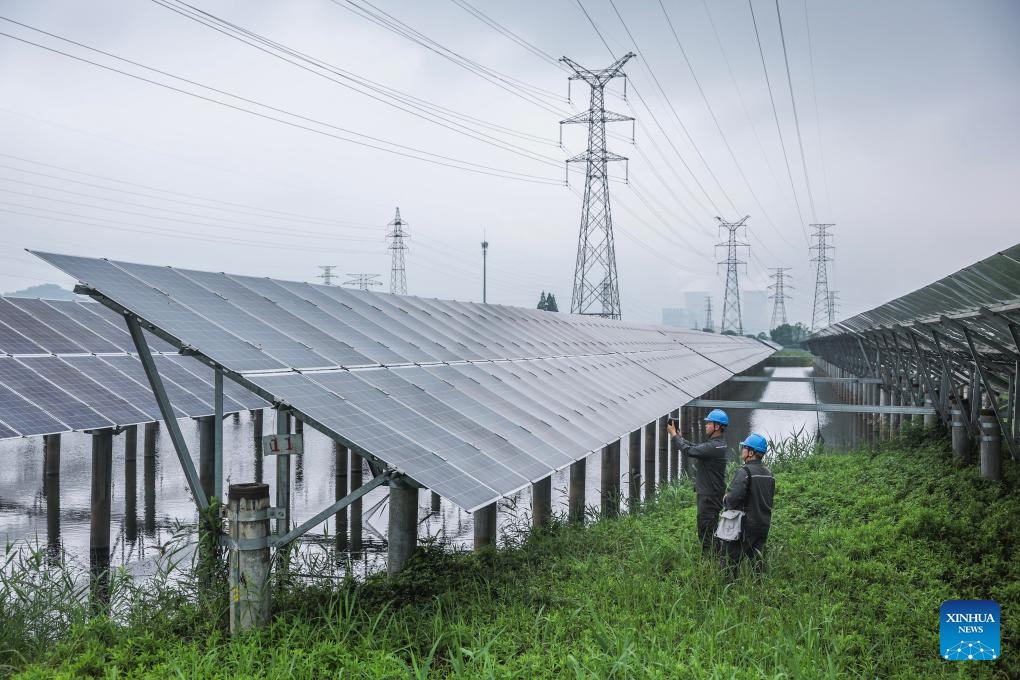
Staff members of State Grid Huzhou power supply company conduct inspection on the photovoltaic lines and equipment at a photovoltaic power station in Changxing County of Huzhou City, east China's Zhejiang Province, May 27, 2026. In recent years, State Grid Huzhou power supply company has been constantly promoting the upgrading of the county-level power grids, advancing the integration of renewable energy sources into power grids, and endeavoring to construct a safer, greener and smarter power grid. (Photo: Xinhua)
Eight Chinese leading polysilicon producers have issued public pledges to stop selling solar products below a cost benchmark, in a fresh industry effort to curb "involution-style" competition and support healthier pricing in the country's photovoltaic supply chain, the Shanghai Securities Journal reported on Friday.
Industry experts said that this move will not only help stabilize profits across the sector, but also promote the Chinese photovoltaics (PV) industry's shift toward high-quality development.
The eight companies jointly committed that the selling prices of all photovoltaic products, including tender bids, must not fall below the corresponding cost calculated under the group standard General Principles for Cost Accounting Models in the Photovoltaic Industry. Any sales below full cost must be "immediately stopped and corrected," according to the report.
The pledge was signed in Shanghai on Thursday by the companies, including four listed companies — Tongwei Solar Co, GCL Technology Holdings Limited, Daqo New Energy Co, Xinte Energy Co. The other four companies are Asia Silicon (Qinghai) Co, Xinjiang East Hope New Energy Co, Qinghai Lihao Qingneng Co, and Xinjiang Goens Energy Technology Co.
Together, the eight companies account for more than 90 percent of China's effective polysilicon production capacity, the Shanghai Securities Journal report said.
Under the initiative, the companies also agreed to accept supervision and inspections from market regulators at all levels and to strengthen mutual oversight. If they discover illegal below-cost sales, they are required to report the issue and file complaints with the industry association and the State Administration for Market Regulation (SAMR).
In addition, the firms committed to strictly implementing China's new energy-consumption standards and to proactively eliminate outdated, high-energy-consuming production capacity.
The move comes just one week after the SAMR held a solar industry price-compliance meeting on July 31, urging solar PV companies to strengthen price compliance and shift competition from price to quality.
It instructed companies to strengthen cost accounting, establish and improve price compliance systems, and carry out comprehensive self-inspections and corrective actions, according to the Xinhua News Agency.
Industry experts welcomed the initiative, saying that years of excessive competition have pushed many photovoltaic firms into losses, which is harmful to the industry's long-term development.
China's PV industry is mired in severe low-price competition, with profit margins squeezed along the entire value chain and many firms operating at a loss, Xiang Ligang, director-general of the Zhongguancun Modern Information Consumer Application Industry Technology Alliance, told the Global Times on Friday.
Xiang added that the initiative could help ensure more reasonable revenue and profit levels, which are essential for sustainable industrial development. The move also reflects a broader shift among Chinese firms toward greater coordination in responding to market pressures.
Although the industry also faces external challenges, including US tariffs on polysilicon-related products, Xiang said the main purpose of the initiative is to improve the sector's own development model rather than simply respond to foreign trade measures.
China has launched sweeping efforts to curb "involution-style" low-price competition and accelerate the phase-out of outdated industrial capacity. China's Ministry of Industry and Information Technology on July 3 held a symposium for manufacturing enterprises, focusing on accelerating the high-quality development of the photovoltaics industry, according to the Xinhua News Agency.
The symposium called for efforts to comprehensively deal with the problem of disorderly price competition in the photovoltaics industry in accordance with laws and regulations, as well as efforts to guide enterprises to improve product quality, phase out backward production capacities in an orderly manner and achieve healthy and sustainable development, Xinhua reported.
。

二 | Shahid Kapoor has finally given fans a glimpse into what awaits him next on the big screen. This venture also marks a long-awaited reunion with one of his most defining collaborators, Vishal Bhardwaj. Speaking about his upcoming film, the actor shared, “What’s next for me as an actor is a movie called Oh Romeo with one of the most prolific filmmakers I have worked with. We have done a version of Hamlet, Haider, and a film called Kaminey, which means rascals. Now this is Oh Romeo, and well, there might just be a Juliet in there too. It’s a love story with a lot of action.”
Oh Romeo, produced by Sajid Nadiadwala, brings together Shahid Kapoor, Triptii Dimri, and Nana Patekar in what is being described as a visually rich, high-octane action thriller layered with romance. Scheduled to release on Valentine’s Day 2026, the film marks the first-ever collaboration between Nadiadwala and Bhardwaj. The first look, released by Nadiadwala Grandson, features a shadowed Shahid in a cowboy hat, his tattooed hand partially covering his face — a striking tease that has already sparked buzz.
View this post on Instagram
A post shared by Instagram (@instagram)
The film carries the thematic echoes of Bhardwaj’s Shakespearean inspirations, subtly hinted at through the title Oh Romeo. Though action-heavy, the romantic core aligns with its Valentine’s Day release. For fans, what heightens excitement is the reunion between Shahid and Bhardwaj after two acclaimed milestones, Kaminey in 2009, and Haider in 2014. Both films showcased Shahid in transformative performances, with Haider earning him a Filmfare Award for Best Actor.
Vishal Bhardwaj, who last directed Fursat and the series Charlie Chopra & the Mystery of Solang Valley. He returns to large-scale commercial filmmaking with Oh Romeo. Meanwhile, Shahid’s most recent theatrical outing was Deva earlier this year. Triptii Dimri was last seen in Dhadak 2.
Also Read: 13 Actors With The Best Biceps。
Current article:http://cfwyi.suilaoheirenzhaizhaikang.sbs/list_etk524e/gdhb1.html
Published on:05:14:10

